
Home → Water Quality → Monitoring → Invasives → Courtesy boat inspections
Courtesy Boat Inspections
Video #1 - DEP’s invasive aquatic biologist John McPhedran demonstrates how to do a thorough boat inspection in under 3.5 minutes.
Video #2 - Developed for Maine’s Courtesy Boat Inspection Program inspectors, this 8 minute video discusses the importance of protecting our lakes and shows how to interact with boaters while walking them through an inspection of their boat.
Related pages: For information on starting your own Courtesy Boat Inspection as well as guidance on training and financial aid, contact Lakes Environmental Association. (off-site)
- Cost Share Grants: cost share grants for local projects to prevent the spread of invasive aquatic plants - inspections and plant removal.
- Courtesy Boat Inspector Handbook (pdf)
Background
Maine has 2,700 lakes greater than 10 acres in size with less than 1% of these infested with aquatic invasive plants. Maine's primary aquatic invasive species (AIS) prevention effort is the Courtesy Boat Inspection (CBI) program. The CBI Program completed its 25th year in 2025. The purpose of these voluntary inspections is to reduce the spread of AIS to Maine waters by boats, trailers, and associated equipment. Trained Courtesy Boat Inspectors alert boaters to the risks posed by AIS, show boaters how to inspect and remove vegetation from boating and fishing equipment, and urge boaters to inspect prior to launch and after retrieval for every excursion onto Maine’s waters.
The Maine Department of Environmental Protection (DEP) contracts with Lakes Environmental Association (LEA) in Bridgton to provide inspector training and assist DEP with grant oversight and communications.
Courtesy Boat Inspection Results Summary - 2025 Season
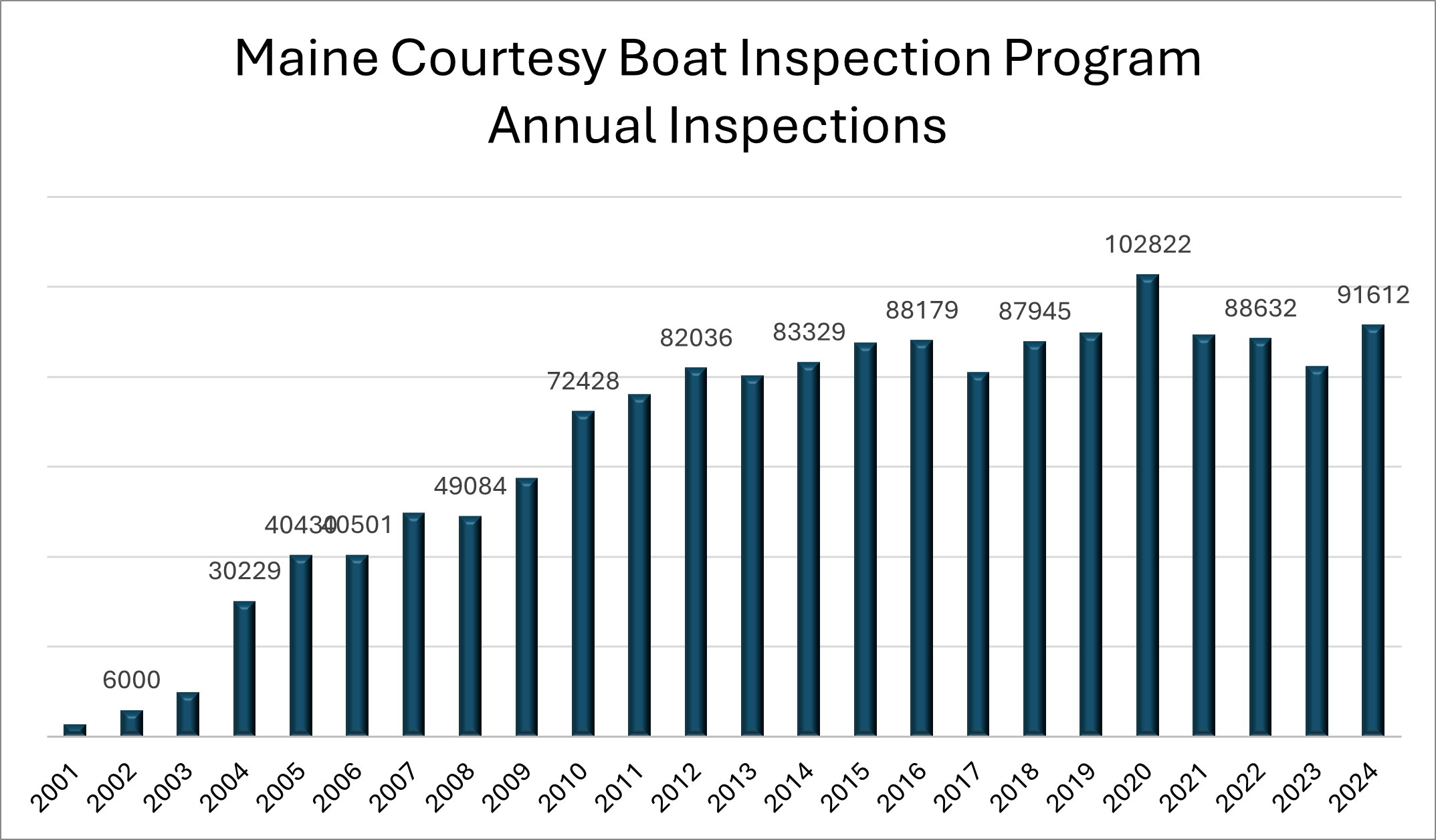
Maine’s 2025 Courtesy Boat Inspection (CBI) program had a record-setting season, submitting 103,179inspection records for CBI groups and Bass tournaments. CBI groups saw 53,612 inspection hours logged. Boats were inspected both entering and leaving the water with most inspections (~60%) conducted on boats entering. Maintaining this high level of prevention effort is a tremendous achievement for local and regional groups running the inspection programs.
BASS clubs participating in tournaments are required to conduct inspections as a condition of their permit from the Maine Department of Inland Fisheries and Wildlife. In 2025, over 30 bass clubs conducted 5,310 inspections of member boats during tournaments. Inspections have remained at or above 80,000 annually since 2012 with the previous record high number in 2020 of 102,822 inspections.
2025 Courtesy Boat Inspection Statistics
- 103,179 watercraft inspected
- 89% of the registered boats had the Lake & River Protection Sticker
- 147 launch sites on 109 waterbodies had inspections occur
- 21 infested waterbodies had inspections conducted at one or more of their access points
- 3,895 inspections (3.8% of all inspections) yielded plant fragments – native or invasive
- Of these intercepted plant fragments, 158 (4.0% of inspections where fragments were found) were “saves” (invasive plants or fragments) found primarily on boats exiting infested waters
- 59 organizations coordinated CBI programs
- 46 bass clubs inspected member boats at their permitted tournaments
- 575 courtesy boat and bass tournament inspectors (paid and volunteer) worked over 54,000 hours
2025 Lake and River Protection Stickers
Maine requires that all boaters using inland waters purchase and attach a Lake and River Protection sticker. For Maine registered boats, this is part of the annual registration sticker. For non-resident boats, the sticker must be purchased separately.
- Percentage of motorized boats with Lake and River Protection Stickers: 90
- Percentage of boats from Maine with sticker: 91%
- Percentage of boats from out-of-state with sticker: 86%
2025 Last Lake Visited Statistics
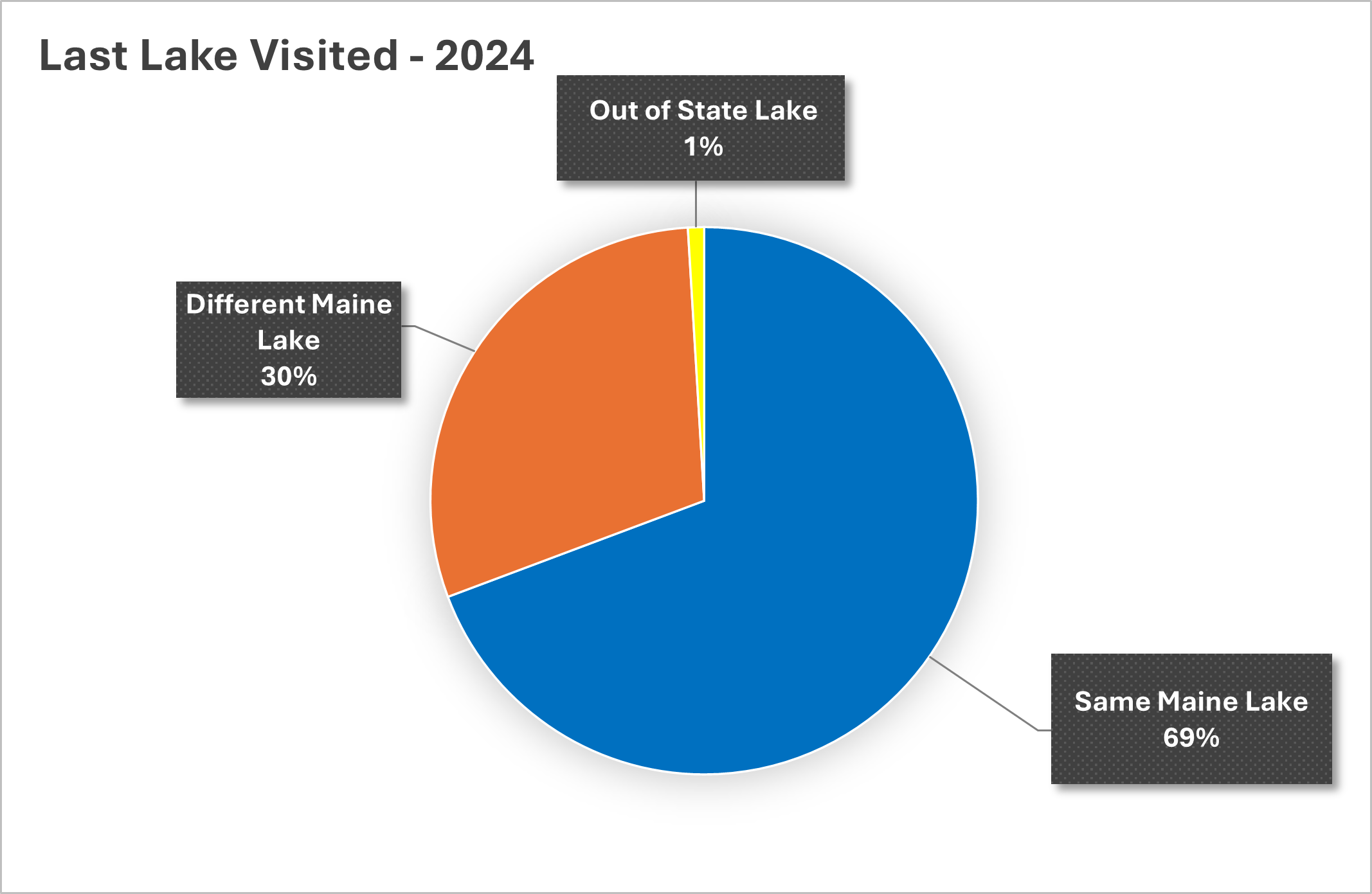
Data is also collected on the last lake visited for all inspections. In 2025, of the 67,310 registered watercraft, 46,639 boaters reported the same lake as their last lake visited. 641 boaters reported an out-of-state lake as their last lake visited prior to launch, and 20,030 said they were on a different Maine lake.
Confirmed "Saves" in 2025
While the Courtesy Boat Inspectors are working hard at preventing invasive plant fragments from entering any waterbody, it is especially important to ensure that fragments of invasive species are not allowed to enter uninfested lakes. 2025 saw 26 saves thankfully with none occurring at uninfested waterbodies. However, it is important to note that vigilance is still paramount in infested lakes in order to prevent the spread of an established infestation to other parts of the waterbody
Plant Location Data
In 2024 an optional question was introduced where inspectors can note the location(s) of any plant fragments found during an inspection. After two seasons inspectors have collected plant location data in 96% of inspections where fragments were found, amounting to over 5,800 records. To date, the data show that a plant is most likely to be found on the trailer whether the boat is entering or leaving the access point. The next most commonly reported location for fragments is on the hull when entering, but on the propellor or motor when exiting a launch. These data are valuable in furthering our understanding of how fragments are transported by watercraft and will continue to be an optional supplement to the data we collect.
This chart tallies inspections where the plant fragment location is identified by the inspector. Since inspectors can find more than one fragment and identify more than one location, this tally is greater than the 5,800 records referenced above. For example, if one inspection states that a plant was found on a trailer and another states that fragments were found on the trailer and the deck, that would add two data points to the trailer column and one to the deck column, even though it reflects data from two inspections.
For more information concerning Maine's Courtesy Boat Inspection Program, visit the Maine DEP's Invasive Aquatic Species Program webpage or the Lakes Environmental Association website, or e-mail DEP at milfoil@maine.gov.