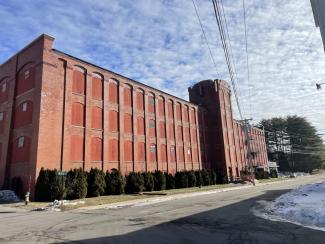
Criterion A: Industry
Period of Significance: 1920 to 1975
Local Level of Significance
The Goodall Worsted Company Alpaca Mill No. 2/Jagger Brothers Mill is locally significant under Criterion A in the area of industry for its association with the production of wool, cloth, and yarn. Mill No. 2 was constructed and operated by two successive textile companies: the Goodall Worsted Company, who ran the mill from 1920 to the 1930s, and Jagger Brothers, who operated it from 1956 to 2019. Both companies played a pivotal role in advancing local textile production and significantly contributed to the economic growth and development of both Springvale and Sanford throughout the nineteenth and twentieth centuries. The Goodall Worsted Company, a textile company of national prominence, just down the Mousam River in Sanford center, purchased the existing Springvale Cotton Mills in 1899 and established the Maine Alpaca Company. By 1920, when Mill No. 2 was constructed across the street from the original Springvale Cotton Mill buildings, the Maine Alpaca Company had become the Maine Alpaca Department, within the Goodall Worsted Company.
The Goodall Worsted Company Alpaca Mill No. 2/Jagger Brothers Mill is the largest and most intact of the two mill buildings that remain of the former Goodall Worsted Company Alpaca complex. Furthermore, it is also the only building from the complex that was associated with Jagger Brothers Company, which has occupied the building for nearly seventy years and is significant in its own right as one of the early companies associated with the textile industry. The Jagger Brothers Company was a significant contributor to the woolen industry in Sanford for four generations over the past 140 years. Uriah Jagger brought worsted spinning, a process involving the combing of long-staple wool to create smooth, strong, and lustrous yarns, to southern Maine in the 1880s, establishing a family-run operation whose high-quality worsted yarns continue today under Jagger Spun. The company’s sustained output and technical excellence helped solidify Maine’s reputation for fine wool production and contributed to the resilience of the American textile industry amid widespread decline. The period of significance commences in 1920 with the construction of the original portion of the mill and extends to 1975, the fifty-year closing date of historic significance. This period includes the circa 1956 addition that was constructed around the time the Jagger Family took over operations.